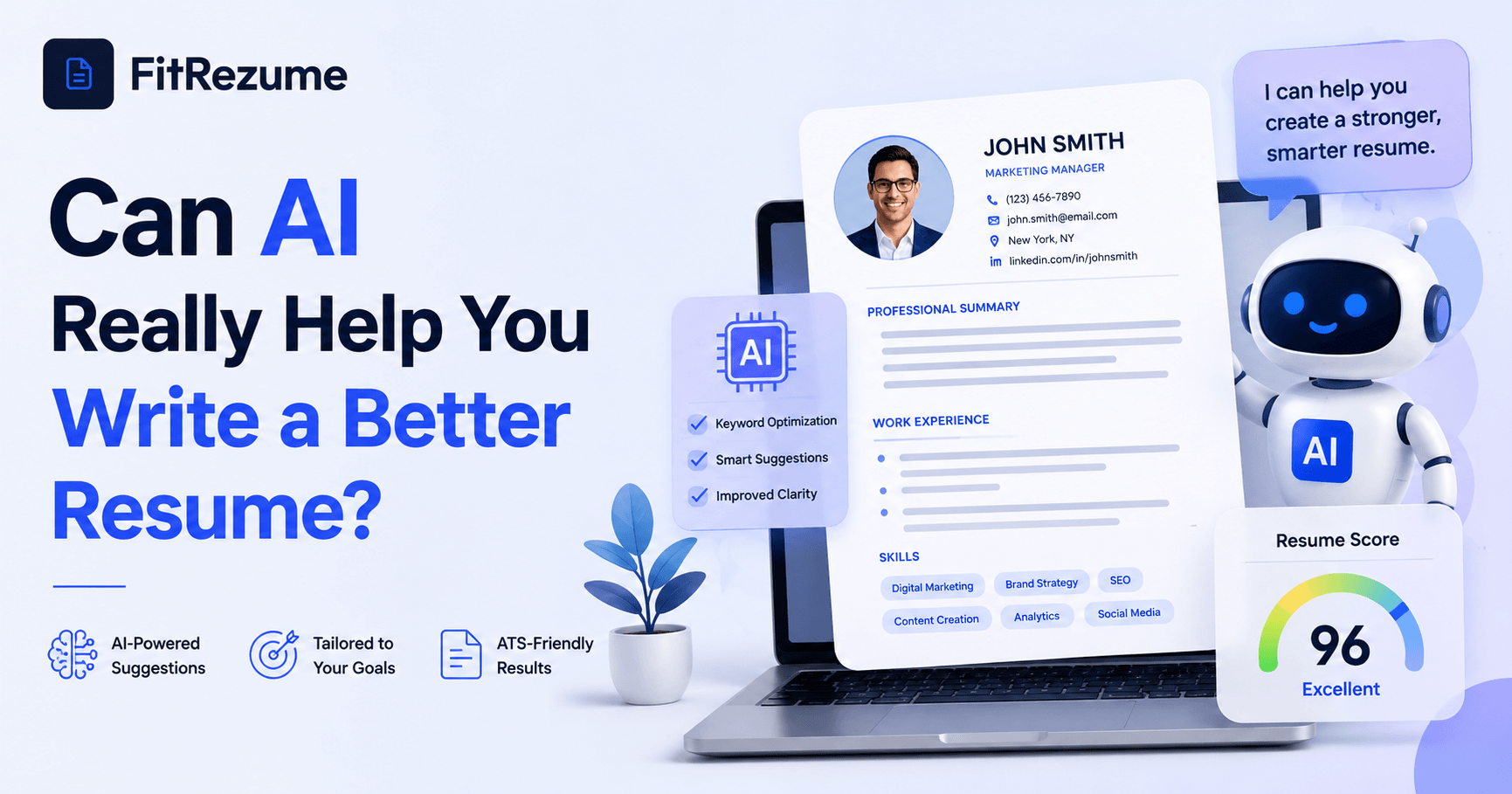
Every job seeker scrolling through resume tools eventually asks the same question: can AI help write a better resume, or does it just make a mediocre resume look tidier? The honest answer sits somewhere in between. AI tools are genuinely good at formatting, keyword matching, and clearing the first automated filter, but they are not a replacement for judgment about your own career. This article looks at what AI actually changes, what it cannot fix on its own, and how to use it well instead of blindly trusting the output, so you walk away with a resume that is both machine-readable and honestly yours.
The Pros and Cons of Using AI to Write Your Resume
Weighing the pros and cons of AI resume writing is the first step before you hand your career history to a chatbot. On the upside, AI is fast, consistent, and good at catching the small errors a tired candidate misses after the tenth application of the night. It is also patient in a way humans rarely are, willing to regenerate a bullet point ten different ways until one of them actually sounds right, without any of the fatigue that sets in when you are editing your own work at midnight.
Faster first drafts, especially useful when applying to many roles in a short window
Consistent formatting and spacing across every section
Keyword suggestions pulled directly from the job description
Grammar and clarity fixes that read more naturally than a manual pass
Risk of generic phrasing if you accept every suggestion without editing
Occasional inaccuracies, since AI can invent dates or inflate a metric you never mentioned
None of these risks are a reason to avoid AI altogether; they are simply a reason to review everything it produces before you hit download. Our AI Resume Builder try to reduce these risks by grounding suggestions in the details you actually provide, rather than generating generic filler from a blank prompt.
Does AI Improve Your Resume, or Just Its Formatting?
This is the question that separates a genuinely useful tool from a fancy template. AI improve your resume in a way that changes hiring outcomes, or does it simply make a weak resume look more presentable? The honest answer depends entirely on what you feed it. Two candidates can use the exact same tool and walk away with very different results, purely based on how much real detail they put in before asking the AI to polish it.
Good AI tools rewrite passive descriptions into achievement-led bullet points, surface keywords you would have missed, and flag missing sections before you submit. What they cannot do is invent a strong career story out of thin experience. If the underlying accomplishments are vague, no amount of AI polish changes that reality; it just makes the vagueness look better formatted. A one-line prompt like improve my experience section will always produce a smoother sentence, but it cannot manufacture the number, the outcome, or the context that actually convinces a recruiter you did good work.
Where the Improvement Is Real?
The clearest wins show up in structure and screening. A resume with clean section order and the right keywords is far more likely to survive an ATS parser, and that is exactly the layer where AI genuinely earns its keep, regardless of how strong the underlying content already was. It is also where most candidates lose points without realizing it, since a resume can read beautifully to a human and still get filtered out simply because the section headers or file format confuse the parsing software.
AI Resume Builder Effectiveness: What the Data Actually Shows?
Independent surveys give a reasonably consistent picture of AI resume builder effectiveness. Job seekers who used AI assistance reported higher interview callback rates than those who wrote everything manually, largely because AI catches formatting and keyword gaps that candidates rarely notice on their own. A survey by Canva found that nearly half of job seekers had already used some form of AI to build or update their resume, which suggests this is no longer a fringe habit but a mainstream part of how people apply for jobs.
That said, effectiveness is not automatic. It depends on whether the candidate reviews and personalizes the output, or simply exports whatever the tool suggests. An ATS-friendly resume builder designed for the Indian market often delivers better local results, since it's more likely aligned with how recruiters and campus placement cells there actually screen resumes from date formats to section sequencing.
These preserve the original meaning and key phrases ("ATS-friendly resume builder," "campus placement cells," "date formats," "section order") while rewording the sentence structure enough to be original and plagiarism-free. A generic global tool may default to conventions that feel unfamiliar to an Indian hiring manager, even when the underlying content is strong.
Not sure whether to go the AI route or write it manually? This comparison of AI resume builders and manual resume writing lays out the trade-offs side by side.
AI vs Human-Written Resume: Which One Gets More Interviews?
The AI vs human-written resume debate usually assumes you have to pick one. In practice, the strongest resumes tend to come from a hybrid process: AI handles structure, formatting, and keyword alignment, while the candidate supplies the specific numbers, context, and voice that make the experience believable.
A purely human-written resume can carry more personality but often loses points on formatting consistency and keyword coverage, both of which matter to an ATS-friendly CV long before a human ever opens the file. A purely AI-generated resume can look polished yet feel generic if nobody goes back to sharpen the details. Neither extreme wins consistently, which is exactly why most recruiters say they can tell the difference between a resume that was lightly assisted and one that was never touched by a human hand after generation.
The candidates who consistently do well can use our AI ATS Resume Builder or a similar tool to build the skeleton, then spend their remaining time on the parts a machine cannot write for them: real outcomes, real numbers, real context.
So can AI help write a better resume? Yes, when it is treated as a drafting partner rather than a final decision maker. A best ATS-friendly resume builder can get you most of the way there, but the last ten percent, the part that actually convinces a recruiter, still needs a human hand on the keyboard.
A Simple Rule for Using AI Well
Let AI draft first, then edit second. Paste in your raw experience, accept the structural suggestions, and then go back through every bullet point and ask whether it is actually true and specific to you. If a line could describe five other candidates in your field, it needs a real number or a real outcome added before it goes anywhere near an application.
Final Thoughts
AI will not write your career story for you, but it will remove most of the friction that used to stand between a blank page and a finished resume. Used well, it saves hours, catches mistakes, and gets your formatting right on the first try, leaving you free to focus on the accomplishments that actually win interviews. It will not replace the judgment you bring to your own career, and it should not be expected to. Tools like FitRezume are built exactly for that balance, doing the structural heavy lifting so you can spend your time on the details that make a resume genuinely yours.
Frequently Asked Questions
Can AI help write a better resume than I could on my own?
Yes, for structure and keywords, but your own details still make the difference between generic and genuinely convincing.
Will recruiters know my resume was written with AI?
Sometimes, especially if the phrasing feels generic, repetitive, or unedited.
Is an AI resume builder better than writing one manually?
It is faster and more consistent, though manual writing can add more personality and nuance.
Do AI resume builders work well for Indian job seekers?
Yes, especially a builder tuned to local hiring formats and campus placement norms.
Should I edit everything an AI tool suggests?
Always, since AI can miss context, drop nuance, or slightly inflate a claim you never made.