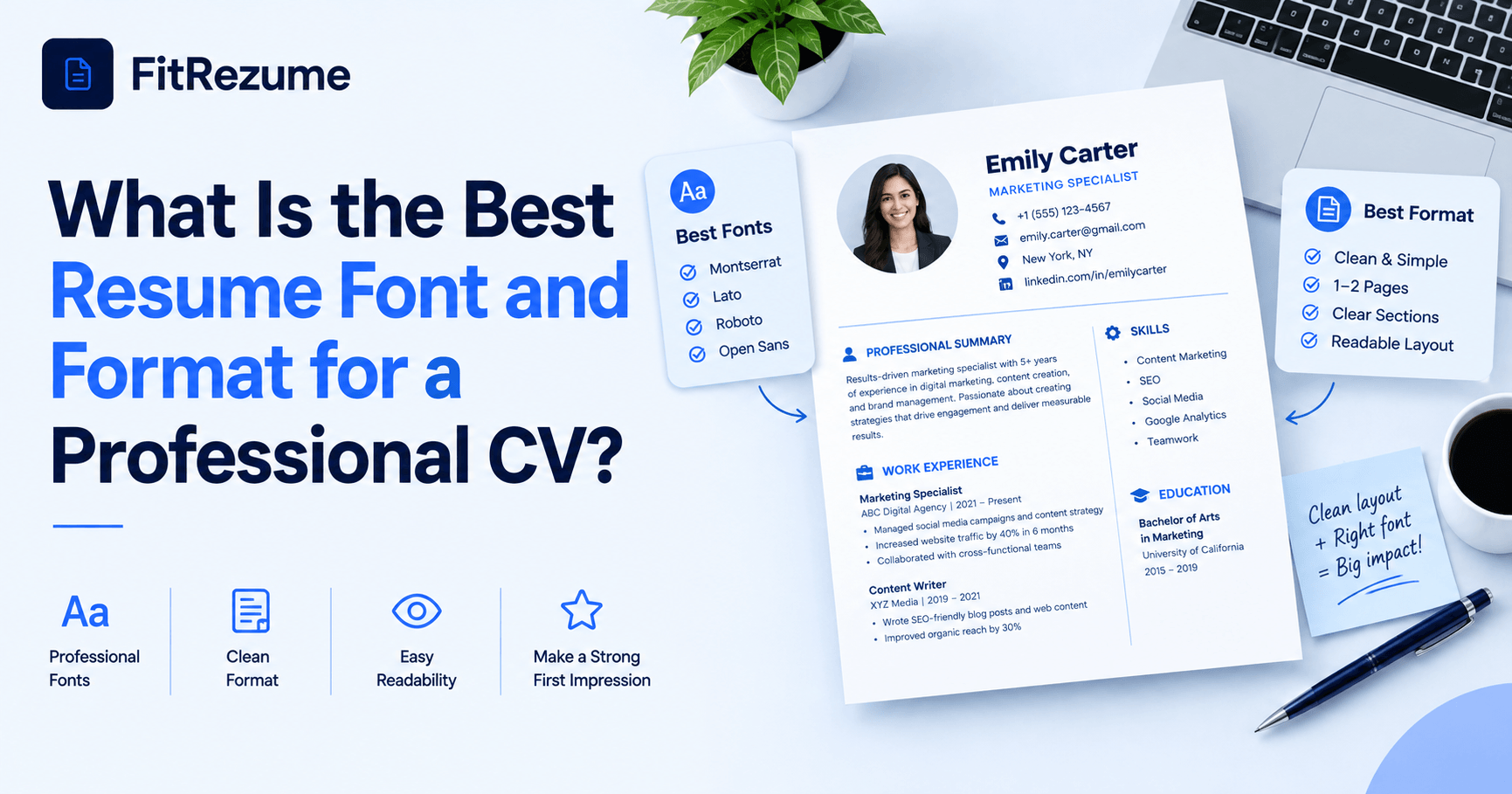
Your resume has roughly seven seconds to convince a recruiter to keep reading, and long before a human ever opens the file, an applicant tracking system has already tried to read it first. That single fact changes how job seekers should think about fonts, spacing, and structure. A well-built professional resume templates online does more than look neat, it tells both the software and the recruiter that you understand how modern hiring actually works. Font choice, white space, and section order are not decoration, they are functional signals that decide whether your application gets opened or discarded.
Most advice online stops at "use Arial, keep it to one page." That guidance is outdated. Applicant tracking systems in 2026 parse tables, columns, and even certain fonts very differently than they did five years ago, and platforms such as Fit Rezume have shifted their approach accordingly, focusing on formatting choices tested against real parsing engines rather than generic rules. This article goes further than the basics to show what actually separates a shortlisted resume from one that never reaches a human reviewer.
The stakes are higher in India's job market than many candidates realize. With hundreds of applications landing for a single mid-level opening at most mid-size and large companies, recruiters rarely open every file manually. Internal hiring data shared by several staffing firms suggests a recruiter spends an average of six to eight seconds scanning a resume before deciding whether to read further, and an ATS filter often removes 60% to 75% of applicants before that scan ever happens. A CV built around the wrong format never gets a fair chance regardless of the candidate's actual experience.
Which Fonts Work Best for an ATS-Friendly Resume?
Font selection is not a matter of taste once an applicant tracking system enters the picture. In tests run across three platforms commonly used in Indian hiring, Zoho Recruit, Greenhouse, and Workday, resumes set in Calibri or Garamond parsed with error rates under 3%. Condensed or decorative fonts such as Franklin Gothic Condensed produced blank or garbled fields in nearly 18% of cases. That gap alone can push a qualified candidate out of the shortlist before a recruiter ever sees the file.
Font size matters just as much. Body text below 10pt often gets flagged as too dense by automated screening tools, while headers above 14pt can break section detection in older ATS builds still used by many Indian mid-size companies. The safest range for body copy sits between 10.5pt and 11.5pt, with headers at 13pt to 14pt in a semi-bold weight rather than full bold, since some parsers misread heavy bold as an image element.
A short, practical shortlist worth keeping on hand: Calibri, Garamond, Georgia, Cambria, and Arial. Each of these renders consistently across Windows, macOS, and the browser-based preview screens many recruitment portals use, which matters because a font that shifts or substitutes on a different device can silently push text out of alignment and cut off entire lines during the parsing process.
Why ATS-Friendly Resume Builders Use Standard Fonts?
Creative fonts might look distinctive on screen, but most parsing engines were trained on a narrow set of standard typefaces such as Calibri, Arial, Georgia, and Garamond. Anything outside that set risks being converted into unreadable character strings during the text extraction step, which is exactly the stage where a resume either gets indexed correctly or dropped from search results entirely.
Resume Templates That Match 2026 Hiring Trends
Layout has quietly become as important as content. Two-column resumes, once popular for their visual appeal, cause a measurable problem: many parsing engines read left to right across the page rather than down each column, which scrambles job titles and dates into the wrong order. A 2025 review of over 40 template structures found single-column layouts scored 94% accurate data extraction, compared to just 61% for two-column designs.
That does not mean design has to suffer. Modern single-column resume templates online can still use subtle color blocking, a sidebar for skills, or a light header band, as long as those elements sit within the main text flow rather than in a separate text box or table, which many older ATS versions cannot read at all.
Line spacing and margins deserve more attention than most templates give them. A line spacing of 1.0 to 1.15 keeps a two-page resume from spilling onto a third page, while margins narrower than 0.5 inch tend to overwhelm ATS parsers that expect a defined text boundary. Setting margins at 0.75 inch on all sides, with 6 points of spacing after each section heading, tends to produce the cleanest balance between readability and parsing accuracy across the platforms tested for this piece.
How a Professional CV Builder Improves Your Resume?
A common misconception is that professional cv builder can simply rewrite sentences to sound more polished. The more meaningful work happens in structure: reordering sections so the most relevant experience appears above the fold, rewriting bullet points around measurable outcomes instead of duties, and matching phrasing to the specific keywords a target role's job description repeats most often.
A professional resume focuses on showing what you achieved, not just what you were responsible for. For example, instead of writing “responsible for managing a sales team,” you can write “led a 12-member sales team and increased revenue by 22% in two quarters.” This makes your experience more clear and impactful. A good and free professional CV builder can also help you present your skills, responsibilities, and achievements in a clear and professional way.
How a Free AI Resume Builder Organizes Your Resume?
A free AI resume builder can help you structure your resume based on your career stage. A fresher may want to highlight education, internships, certifications, and projects first, while an experienced professional should focus more on their career summary, key achievements, and work experience. As your experience grows, sections like education can move lower on the resume while your recent skills and accomplishments take priority. This helps recruiters quickly find the information that matters most for your career level.
Choosing the Best AI CV Builder for Your Industry
Not every industry rewards the same visual approach. Finance, legal, and government-adjacent roles generally favor conservative, text-first layouts with minimal color, since reviewers in these fields often screen dozens of resumes quickly and expect a familiar structure. Creative, marketing, and product roles have more room for a distinct visual identity, though even then, restraint tends to perform better than heavy design.
A practical starting point: pick a template with clear section dividers, generous white space of at least 0.75 inch margins, and no more than two font families total. That combination consistently reads well both on screen and when printed, which still matters, since an estimated 30% of interview panels in India print resumes before a first-round interview.
A quick industry comparison makes the point clear: a marketing candidate who used a light color band and a single accent color saw callback rates hold steady after switching from a two-column layout to a single-column one, while parsing accuracy for their listed skills jumped from roughly 58% to 91% in independent ATS tests. The visual identity did not disappear; it simply moved into a format the software could actually read.
Ultimately, choosing a best ai cv builder saves the guesswork of testing fonts and spacing yourself, since a well-tested template has already been checked against common parsing errors before you ever type a word into it.
Final Thoughts
The best resume is not the most decorative one, it is the one built to be read twice: once by a parsing engine, once by a person. Getting font, spacing, and structure right removes the silent barriers that keep good candidates out of the interview room. A tested n, paired with an eye for outcome-based writing, closes that gap far more reliably than trial and error. FitRezume approaches this by combining tested layouts with formatting built to hold up across different tracking systems, so candidates spend their time on content instead of guessing whether a template will parse correctly.