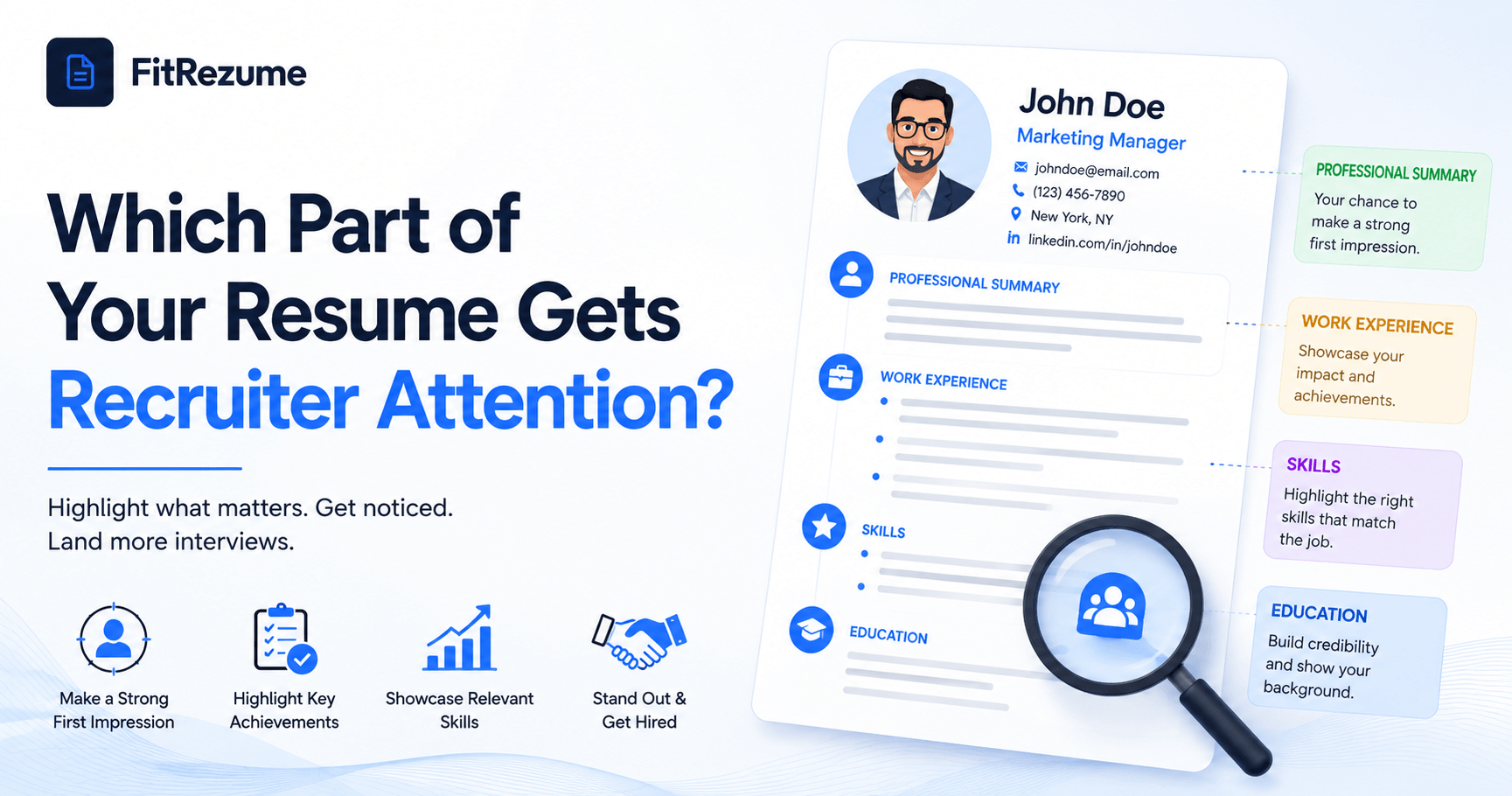
If you have ever wondered why a strong background still gets ignored, the answer usually comes down to structure, not skill. Recruiters do not read resumes top to bottom like a novel. They scan, and within seconds, they have already decided which lines matter and which lines do not. Understanding the resume sections that matter most is the difference between landing an interview and disappearing into a pile of a hundred applications. This article breaks down exactly where recruiter attention goes, why it goes there, and how you can rebuild your resume around that behaviour instead of against it, using real eye tracking research instead of guesswork, so every section on the page is pulling its weight rather than sitting there unread.
What Recruiters Look at First When They Open Your Resume?
The moment a recruiter opens a resume, their eyes do not move randomly. Eye tracking research on hiring behaviour shows a consistent pattern: the top left quadrant of the page gets scanned first, and it gets scanned hardest. This is exactly what recruiters look at first: name, current job title, current company, and dates. If any of these four details are missing, unclear, or buried below a long paragraph, the resume risks getting set aside before the recruiter even reaches the skills section. It sounds harsh, but recruiters are not being careless; they are simply managing a stack of applications with only a few minutes to spare per role, not per resume.
This is why the resume sections that matter most are rarely the ones candidates spend the most time perfecting. Job seekers often polish their objective statement or interests section while ignoring formatting inconsistencies in their header. Recruiters are moving fast, comparing dozens of resumes against a single job description, and they simply do not have the patience to hunt for information that should be obvious at a glance.
Why the Top Third of the Page Decides Everything?
Most rejections happen before a recruiter ever reaches your projects or certifications. If the top third of your page does not clearly answer who you are and what you currently do, the rest of the document rarely gets a fair read. This is also why a resume built on an outdated or cluttered template quietly costs candidates interviews, and why a clean, ATS-friendly layout, of the kind covered in this guide to ATS-friendly resume templates, tends to outperform a visually busy one.
How Recruiters Scan Resumes: The 6-Second Rule?
Multiple studies, including biometric eye-tracking research conducted with professional recruiters, point to the same figure: roughly 6 to 7 seconds is all a resume gets on the first pass. Understanding how recruiters scan resumes explains why layout beats content length almost every time.
The scanning pattern generally follows an F- or Z-shape. Recruiters read across the top of the page, drop down the left margin, and then scan horizontally again wherever a bolded title or bullet point catches their eye. Dense paragraphs are usually skipped entirely, while short bullet points that lead with numbers tend to hold attention longer.
This scanning behaviour is also why formatting problems cost more than most candidates realise. A resume packed with graphics, tables, or unusual fonts disrupts this natural scanning flow, whether the reader is a human recruiter or an ATS parser reading the same file a few seconds later.
The Cost of a Cluttered Layout
A resume can have excellent experience and still fail this scan if the layout works against it. Two-column designs, photo headers, and coloured sidebars often look impressive to the candidate but confuse both the recruiter's eye and the ATS parser reading the file behind the scenes. When the scanning path breaks, recruiters do not stop to figure out where information moved; they simply move on to the next application in the pile. Keeping the structure predictable- one column, clear headings, consistent spacing- is what lets the natural F pattern do its job instead of fighting the design. It is a small change on paper, but it is often the single biggest lever candidates have, well ahead of rewriting bullet points or chasing a longer skills list.
The Resume Attention Heatmap: Where Eyes Actually Go?
A resume attention heatmap built from infrared eye tracking data shows exactly where hiring managers linger and where they never look at all. Bright zones cluster around the top third of the page. Everything below the halfway mark, especially the bottom right corner, receives almost no visual attention during that first scan.
Based on this research, six fixation points capture most of a recruiter's attention:
Candidate name, always the very first thing scanned
Current job title and company, used to judge relevance instantly
Employment dates, checked to spot gaps or short tenures
Previous job title and company, used to judge career progression
Education, given a quick glance mainly to confirm the degree
The first two bullet points under the most recent role
Everything else, including a long summary paragraph, a crowded skills list, or hobbies, gets read only if these six points pass the initial filter. This is exactly why the resume sections that matter most should be arranged in the order a recruiter naturally scans them, not the order that feels comfortable to write. If your current layout buries your job title below a paragraph of text, it may be worth reviewing the formatting checklist in this guide on the 8 things every ATS resume needs.
Fixing Your Resume Sections with the Best AI Resume Builder Online
Once you know which zones matter, the real work is rebuilding your resume around them. This is where the best AI resume builder online becomes genuinely useful instead of just a formatting shortcut. A good builder does not simply make a resume look neat, it enforces the hierarchy that eye tracking data recommends: name and title up top, achievements with metrics near the start of each role, and dead weight pushed further down or removed entirely.
Fitrezume is built around this exact principle. Instead of leaving section order to guesswork, it structures every resume so the highest attention zones carry the strongest information first. For students and early career professionals in India who cannot afford a wasted six second scan, this kind of structural discipline matters as much as the words themselves.
If you would rather have an expert handle the structuring for you, professional CV writing services in India exist for precisely this reason, they already know which sections recruiters prioritise across different industries and seniority levels. Whether you choose a tool or a writer, the goal stays the same: put your strongest information exactly where a recruiter's eyes will land first, every single time.
When to Use a Builder vs a Professional Writer?
A builder is usually the faster route when you need a properly ordered resume within the hour, especially before a campus drive or a last-minute application. Professional CV writing services in India tend to make more sense for senior professionals or career switchers who need a narrative built almost from scratch. Either path works, as long as the final document respects how recruiters actually read.
Final Thoughts
Recruiter attention is not evenly distributed, and pretending otherwise is the fastest way to waste a good career story. Once you accept that the top third of the page carries most of the weight, every editing decision gets easier: what to move up, what to trim, and what to remove altogether. None of this requires rewriting your entire career history; it just requires putting the right facts in the right zone before a recruiter's eyes ever get there. Tools like Fitrezume simply automate this discipline so you do not have to guess where the attention actually goes, freeing you up to focus on the achievements themselves rather than the formatting around them.
Frequently Asked Questions
Which resume section do recruiters look at first?
The header, specifically your name, current title, current company, and dates.
How long do recruiters actually spend on a resume?
Roughly six to seven seconds during the first pass before deciding to read further.
Do these attention patterns apply to every industry?
Yes, though the weighting shifts slightly for creative, design, and portfolio-led roles.
Can an AI resume builder fix poor section order automatically?
Yes, tools such as FitRezume auto-arrange sections by attention priority as you type.
Should freshers choose a professional CV writing service or a builder?
It depends on budget and timeline; both approaches target the same recruiter scanning pattern.