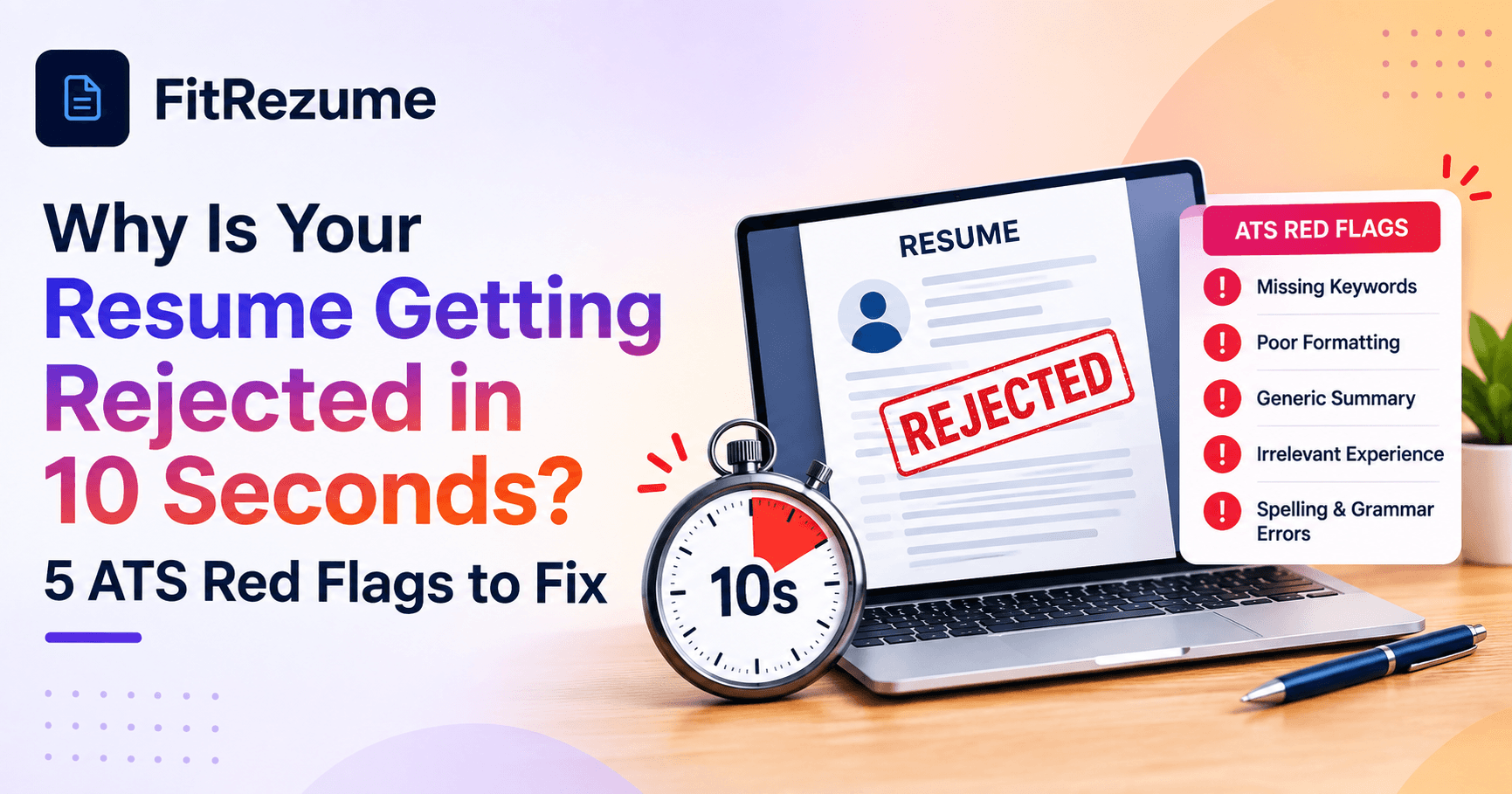
You spend three hours polishing your resume, hit submit, and then nothing happens. No callback. No rejection email. Just silence.
Here is the uncomfortable part. Most resumes never reach a human recruiter at all. An Applicant Tracking System, or ATS, scans and often rejects a resume in under 10 seconds. If your resume is not built as an ATS-friendly resume, it can get filtered out before anyone reads a single line, no matter how qualified you are.
This is not about stuffing keywords into a document. It is about the exact structure the software reads first. Below are five specific red flags that trigger instant ATS rejection, why each one happens, and how to fix it today.
Why You Need an ATS-Friendly Resume Before You Apply?
In India, a single entry-level opening can attract over 250 applications within 48 hours. Companies do not have the bandwidth to read every resume by hand, so most mid-size and large employers now run applications through ATS software first. That single filtering step decides who a recruiter ever sees.
Consider two candidates applying for the same analyst role. Both have identical experience, but one resume uses a two-column, icon-heavy layout, and the other uses a plain, single-column structure. Industry estimates suggest the second candidate is far more likely to have their full work history extracted correctly, simply because of formatting, not talent.
Red Flag 1: Multi-Column Layouts and Graphic-Heavy Designs
Two-column resumes look sharp on screen, but most ATS engines read left to right, top to bottom, in a single stream of text. When a layout splits into columns, the parser can merge a job title from one column with the company name from another, scrambling an entire work history into nonsense.
This happens because ATS software is built to extract plain text, not visual design. Icons, text boxes, tables, and graphics inside a resume often get skipped entirely, or worse, dumped into the wrong field, so a skills section can vanish completely from the data a recruiter finally sees.
A single-column, text-based layout with a standard section order (contact details, summary, experience, education, skills) avoids this problem completely. FitRezume’s ATS-friendly online resume builder in India automatically creates the right structure, so candidates don’t have to worry about what the software can or cannot read.
How an ATS-Friendly Resume Builder in India Fixes Formatting Traps?
Most people assume "ATS-friendly" just means a plain font. It actually means something more specific: every heading uses standard tags in the underlying file, every date follows one consistent format, and nothing sits inside a header, footer, or text box, because those three zones are often invisible to parsing software entirely.
This last point surprises even experienced job seekers. A phone number or email address placed in a document header can be completely skipped by certain ATS platforms, which means a perfectly qualified candidate gets marked as having no contact information at all, even though the details are clearly visible to the human eye.
The Truth About ATS-Friendly Resume Templates Online
A quick search for free resume designs returns thousands of results, and most of them are built for visual appeal on design platforms, not for parsing software. Many resume templates labelled as ATS-safe on download sites have never actually been tested against real ATS engines before being published.
Red Flag 2: Image-Based Text and the Wrong File Format
Saving a resume as a flattened image, or exporting a heavily designed PDF from a graphic tool, can turn readable text into pixels that no parser can extract. Some older ATS platforms, still common among Indian recruitment agencies, also struggle with certain PDF exports and parse a properly formatted .docx file more reliably.
The reason is technical: PDF files store text as positioned characters rather than a linear stream, and design-heavy exports sometimes encode text as outlines or embedded images rather than selectable characters. If a resume cannot be highlighted and copied cleanly in a PDF viewer, an ATS likely cannot read it either.
The fix is to test a resume before submitting it. Open the file, try selecting all the text with a mouse, and paste it into a plain notepad. If the words appear jumbled, missing, or out of order, the ATS will see the same mess. Genuine ATS-friendly resume templates online are built and tested specifically against this kind of extraction, not just designed to look clean on a screen.
A useful benchmark: if a copy-paste test produces clean, readable text within 5 seconds, the file structure is very likely safe for most ATS platforms in use across Indian hiring today.
Getting the Right CV Format for Job in India
Global CV advice does not always translate directly to Indian hiring pipelines, where recruiters and ATS platforms expect certain conventions that differ from resumes built for the US or UK market.
Red Flag 3: Non-Standard Section Headings
A heading like "My Journey" or "Where I Have Been" might read as creative to a person, but an ATS is trained to recognize standard labels such as Work Experience, Education, and Skills. Anything outside that expected vocabulary risks being ignored or filed under the wrong category entirely.
For candidates applying across Indian sectors, from IT services to finance to manufacturing, sticking to conventional headings and a reverse-chronological order gives both the software and the recruiter a familiar structure to scan quickly, often in well under 30 seconds.
Red Flag 4: Date and Duration Formatting Errors
Indian candidates often list education years as "10th (2015), 12th (2017)" or use day-first date formats like 05/06/2022, which can confuse ATS platforms originally built around US date conventions. A mismatch here can misread employment duration entirely, sometimes shortening a candidate's actual experience on paper by a year or more.
The safer approach is writing months out in full, such as June 2022 to March 2024, and listing education with degree name, institution, and year in a consistent pattern throughout the document. This single adjustment is part of what a properly structured CV format for job in India actually requires, and it is rarely covered in generic global resume guides aimed at Western markets.
When Should You Use a Professional CV Template?
Not every red flag is about formatting. Some cv templates are technically clean but still get rejected because the content itself never matches what the job description is actually asking for.
Red Flag 5: Missing Job-Specific Keywords and Skill Clusters
ATS scoring does not just check whether a keyword exists somewhere on the page, it often checks whether skills appear in context, grouped near relevant experience rather than dumped into an isolated list. A resume that lists Excel once in a skills section scores differently than one that shows Excel used inside an actual project description with a measurable result.
This is where many self-written resumes fall short, not from lack of skill, but from not knowing how the specific job description's language should be mirrored back into the experience section. A recruiter posting a role for a data analyst and one posting for a business analyst may want overlapping skills described in very different wording, and generic resumes rarely make that distinction.
This is exactly the gap that professional CV templates in India are built to close, since a trained writer reads the job description first and reverse-engineers the resume content around it, rather than writing one generic document and reusing it everywhere. FitRezume’s ATS-friendly online resume builder automatically creates the right structure, so candidates don’t have to worry about what the software can or cannot read.
What a Strong CV Writing Service in India Actually Delivers?
Beyond rewording bullet points, a strong writing service should run the finished document through actual ATS simulation software, check formatting against the five red flags covered above, and confirm the file opens cleanly across at least two or three different applicant tracking systems, not just one. Anything less is closer to basic proofreading than a genuine ATS review, and it defeats the purpose of paying for expert help in the first place.
Final Words: Fix the Filter Before You Fix Anything Else
A resume rejected in 10 seconds rarely fails because a candidate lacks the right experience. It fails because the software reading it first could not extract that experience correctly. Fixing multi-column layouts, testing file formats, using standard headings, formatting dates consistently, and tailoring keywords to each job description are five changes that take an afternoon, not a career change.
Building an ATS-friendly resume from the start removes this guesswork entirely, and services like FitRezume exist precisely to handle this structural work so a candidate's actual experience finally gets the chance to be read by a person instead of getting stuck at the very first digital filter.
None of these fixes require expensive tools or weeks of effort. A single afternoon spent auditing a resume against these five red flags can be the difference between silence and an interview call, and an ATS-friendly resume built correctly the first time keeps working for every single application that follows.
Frequently Asked Questions
What makes a resume ATS-friendly?
It uses a single-column, text-based layout, standard section headings, consistent date formats, and no content hidden in headers, footers, or images.
Why do ATS systems reject resumes in seconds?
The software parses structure before content, so complex layouts, image-based text, or non-standard headings get flagged or misread instantly.
Can I use tables and columns in an ATS resume?
It is safer to avoid them, since many ATS parsers read text in a single top-to-bottom stream and can scramble multi-column data.
What is the best CV format for job applications in India?
A reverse-chronological format with standard headings, full month names, and consistent education formatting works best across Indian ATS platforms.
Are professional CV writing services in India worth it?
They are useful when a resume is technically clean but still not landing interviews, since a good service tailors content and verifies ATS compatibility together.